
On Nov 17, 2026 local time, OpenAI officially released two newly upgraded flagship models — GPT‑6.2 Astra and GPT‑6.2 Sol. These two models continue the GPT‑6 series' dual‑track strategy, respectively targeting high‑difficulty professional tasks and efficient everyday work scenarios, and achieve notable improvements over the previous generation in performance, efficiency and API cost. The company emphasizes that the new models can complete higher‑demand tasks with fewer output tokens, helping users accomplish more work within the same usage quota.

Core performance comparison with previous generations
GPT‑6.2 Astra is positioned as a cutting‑edge model for the most complex professional work, directly succeeding GPT‑6 Astra. OpenAI's published data show that on the Agents’ Last Exam multi‑step professional workflow benchmark, GPT‑6.2 Astra scores 5.2 points higher than GPT‑6 Astra, while single‑task cost is less than one‑third of its predecessor. In the Terminal‑Bench‑Science 0.1 science‑related evaluation, the new model improved by about 9 percentage points, which OpenAI cites as evidence of stronger performance in scientific research scenarios.
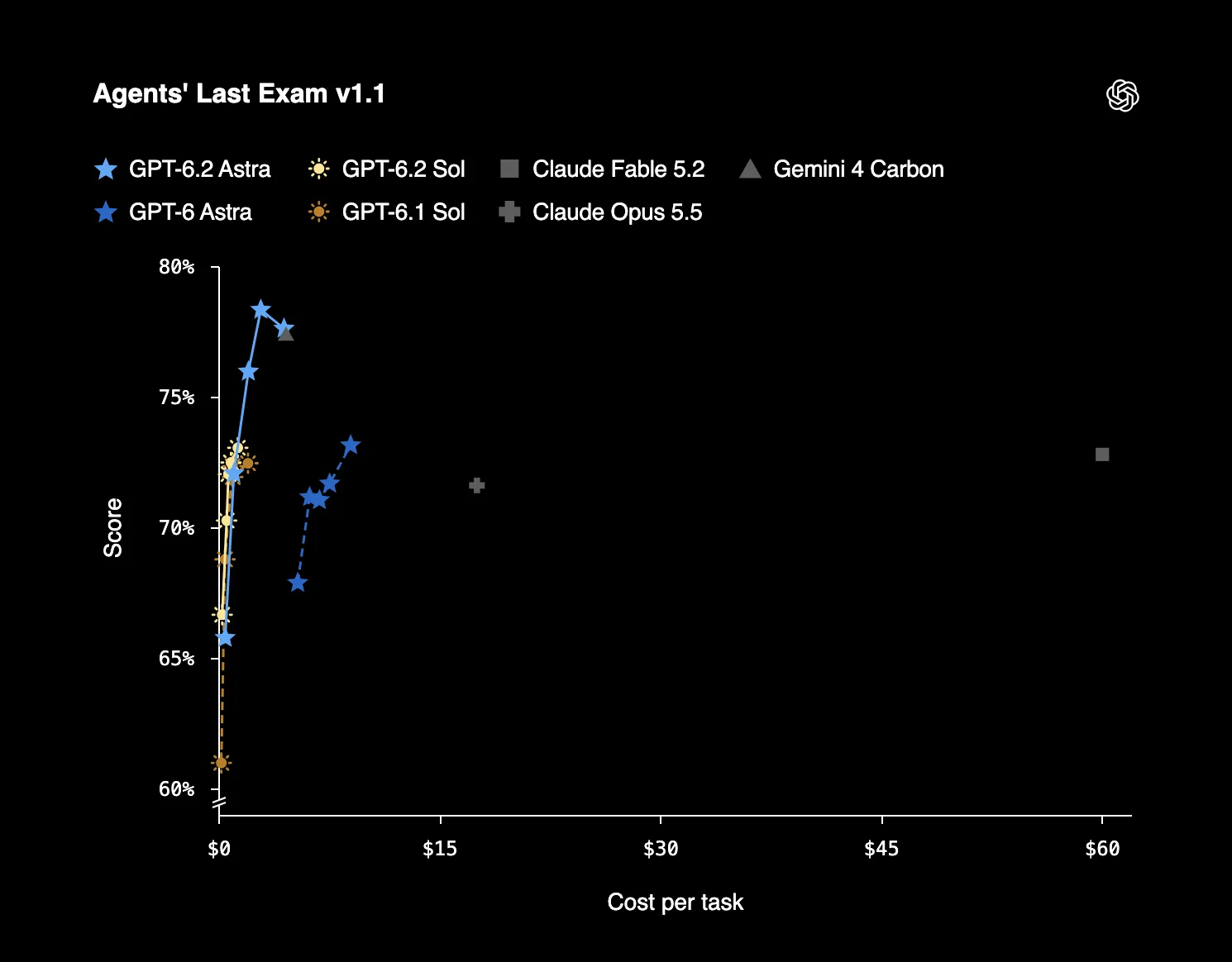
On cost, GPT‑6.2 Astra's API pricing is $8 per million input tokens and $40 per million output tokens, roughly a 20% reduction versus the prior generation; cached input pricing has also been significantly lowered. Independent evaluator Artificial Analysis reports that GPT‑6.2 Astra ranks highly on its Intelligence Index and occupies an advantageous position on the cost‑task Pareto frontier. This means users can obtain higher or similar capability while spending noticeably less.
GPT‑6.2 Sol is positioned against GPT‑6.1 Sol as an efficient, general‑purpose model for everyday work. OpenAI states the new version improves on multi‑step agent workflows, clear natural writing, and collaboration experience. In Cognition's FrontierCode 2.0 coding benchmark, Sol approaches Astra's performance at about one‑fifth the cost. Many internal teams have already adopted it as the default for both technical and non‑technical tasks. Compared with GPT‑6.1 Sol, the new Sol can complete more tasks under the same paid quota, mainly due to higher token efficiency and stronger task completion ability.
Both models emphasize "completing higher‑demand tasks with fewer output tokens." This improvement is reflected in user experience: in ChatGPT Work and Codex, users can handle more complex requests before reaching usage limits. OpenAI also notes that, because of capability gains, both models employ stricter safety guards in high‑risk cybersecurity‑assist scenarios.
Specific capability improvements and scenario adaptation
In professional workflows, GPT‑6.2 Astra produces slides, website front‑ends, and 3D designs that better conform to professional standards and user templates. Early test feedback indicates that when modifying and testing code in existing projects, code style is cleaner, tests are more focused, and rework cycles are reduced. Improvements on science and research‑related benchmarks also make it better suited to workflows that require long‑term reasoning and tool invocation.
GPT‑6.2 Sol focuses more on high‑frequency daily tasks. It performs consistently in coding, document processing, and multi‑step agent flows, and is described as "intuitive and easy to collaborate with." Compared with the prior generation, it narrows the capability gap with top‑tier models while maintaining lower cost, making it especially suitable for developers and enterprise users seeking a balance between cost and performance.
At the API level, both models support approximately 1.05 million token context windows and accept text and image inputs. Developers can call gpt-6.2-astra and gpt-6.2-sol directly. The Ultrafast mode has also been expanded: Pro $500 tier users can use this mode on both models, and Pro $200 tier users receive Ultrafast support for Sol for the first time. Enterprise and education editions require administrators to enable the relevant permissions. Partner platforms such as GitHub Copilot have also announced support for these models for agent‑style coding and code review.
Release background and industry impact
This release arrives amid continuous iterations of the GPT‑6 series. OpenAI previously released GPT‑6 Astra and GPT‑6.1 Sol; the 6.2 update emphasizes efficiency improvements and cost optimization rather than simply increasing parameter scale. Through the Astra and Sol dual‑track strategy, OpenAI aims to cover both high‑end professional demand and large‑scale everyday usage. Cost reductions and token‑efficiency gains help lower practical usage barriers for enterprises and developers, while tightened safety guards respond to earlier concerns about high‑risk applications.
Objectively, the officially published benchmark improvements and cost data are relatively clear, but real‑world effects still depend on specific workflows and evaluation scenarios. Some independent evaluations indicate the new models can still exhibit hallucination rates or judgment biases in certain professional domains; users in high‑sensitivity areas such as legal and finance should carefully verify outputs. Market and developer community feedback will further validate these claims.
The release of GPT‑6.2 Astra and GPT‑6.2 Sol marks OpenAI's continued progress in model efficiency and scenario adaptation. Compared with the previous generation, the new models maintain or improve capabilities while significantly lowering per‑task costs, enabling users and developers to accomplish more and more complex work within the same budget. However, code generation scores have regressed and safety in that area also lags behind the prior generation, which will need to be addressed in future models. As the models roll out across ChatGPT, Codex and the API, subsequent real‑world usage data and third‑party evaluations will more clearly reveal their true value.
▶️ Enjoy this article? Creating it is hard work!
Subscribe to our YouTube channel:
AI Rosetta
Your likes, subscriptions and shares are our greatest support! 🙏
For more AI news visit: https://www.airosetta.com